Showing posts with label survivor. Show all posts

Saturday, February 24, 2018

THINGS WE HAVEN'T SAID is now available!

If you've been following the publication journey of THINGS WE HAVEN'T SAID, an anthology of 25 survivors of Sexual Assault, you probably know this has been a long 2 years. However, the end has come: Things We Haven't Said has been published as of March 13, 2018 and will be available everywhere books are sold.

One thing especially important for books such as these, which may otherwise be missed by some readers, is to post your honest reviews as soon as possible on as many sites as possible. Your review may help other readers find books they might otherwise miss out on. Thank you very much for your support!

As you follow the links below, please note the website stores where reviews are lacking, and share your review there so other readers can find books you recommend they read. Again, thank you very much for this critical support.

Amazon especially promotes books with 50 or more reviews. Early word can help us reach more readers and help more survivors. Remember, proceeds are being donated to www.rainn.org and to the Voices and Faces project, at www.voicesandfaces.org


Here's a listing of those sites who currently list THINGS WE HAVEN'T SAID for pre-order:

1. Amazon:


2. Barnes & Noble:


3: Book Depository:


4: Books-A-Million:


5: Indiebound:


6: GoodReads:


Please note that the majority of the proceeds from the sale of this book will be donated to:


The contributors have donated their time, their talents, and their poems, stories, and essays to speak up and speak out on the issue of sexual assault. In light of the #MeToo and #TimesUp movements, survivors have stepped out and choose to remain no longer silent about sexual abuse, sexual trauma, rape, incest, and sexual assault. By remaining silent, power remains with the abuser. By speaking out, survivors regain their voice, and begin to heal. Each of us who have contributed, myself included, have experienced healing as a result of speaking out. It is our hope that readers will also find hope and healing from their own Sexual Violence experiences.

For many survivors, it's hard enough to face the truth that sexual assault has even occurred, let alone, speak up about it. Unfortunately, many are ill-equipped to handle such trauma and the very real aftermath from which survivors suffer daily across years and decades. Obviously, there is a huge need for such a resource as this one, detailing from fellow survivors themselves the ways we have learned to heal and move forward in our treatment and recovery. Many families, even those with the best of intentions to support and help survivors heal, have no idea what to say or how to even begin the healing process. Thus, a book like THINGS WE HAVEN'T SAID, provides such a resource for teens and adults to slowly process their experiences and co-journey with other survivors who have made progress toward healing on their recovery journey.

Please consider purchasing a copy for yourself, your loved one, your children, the people you love, and for your community crisis center, your local women's shelter, your local churches, and your local libraries. We appreciate each and every one of you, and welcome you to share the word so others know there is hope, there is a resource, and when you purchase this book, know that you are making a difference, and the majority of your purchase will be donated to www.RAINN.org and www.voicesandfaces.org


Thank you!


Saturday, July 1, 2017

For Survivors: Icebergs, Recovery, and the Importance of Using Your Voice

 
I don't know what your recovery pathway looks like compared to mine, but I've been walking mine out for nearly 40 years. In those four decades, I've made some progress, have experienced fallouts and fallbacks, and I've discovered things about myself I would never have known had I not done the hard work of digging below the surface and asking the hard questions. I also had to sort through a lot of difficult things, and there were times this was triggering for me. However, at the end of the day, I can look back and honestly say that it is ENTIRELY worth every pain, every trigger, and leaning into that pain and allowing myself to fully experience that as honestly as I can has made all the difference.

I can't answer for you whether this is a good way to go about walking out your pathway, but I encourage you to take the risk, or at the very least, allow yourself to consider the possibility that you can. Read on if you'd like to know more. As I often say, take whatever is helpful, and toss out the stuff that doesn't work for you. My solutions may not work for you. When you try something that doesn't work, shrug it off. That's just a sign you're not there yet, you're not ready for that yet, or it's just not right for YOU. That's okay. Be you. Be where you're at and do the best you can with where you're at. It's that simple. Or, it can be, if you let it.


The beginning of this process may be a bit off-putting for the person in recovery. As is very often the case, once you start digging, you tend to uncover more and more, and very soon you may become overwhelmed with what you dig up. It can be helpful to know beforehand that this is a very normal part of the process. After all, we aren't 2 dimensional beings. We're very complex, far more than we often give ourselves credit. That may ping onto that false belief you're holding onto that you're broken, unworthy, or an outsider. I'll come back to that later. For now, just know that's a lie, and you are worthy, wonderful, and just as valuable as everyone else.


It's high time you stop believing your abuser, turn those tapes off from replaying over and over in your mind, and replace them with positive thoughts, affirmations, and mindfulness. This will lead you to wellness, which is a much healthier place to exist. You've beat yourself down for far too long, in fact, you may have even taken the shovel out of the hands of your abuser, and done the burying of yourself on their behalf. Stop it. Enough of that. It's time to unbury some stuff and get to the truth of your actual identity. See yourself the way the rest of the world sees you. Look in that mirror. You might be surprised. It will take your breath away.


What you may find, beneath the surface of your true identity, is a person far more complicated than you have even risked thinking about. You probably think very little of yourself, or when you're in the early stages of recovery, it's much easier to believe this is true. Well, let me say it: It's a lie. Untrue. Not even close. You. Have. Value. You. Are. Amazing. You are beautiful and wonderful, and never let ANYONE, even yourself, tell you otherwise.

Let that soak in for a minute.

Think of yourself as an iceberg. This might also match how your feelings have become over the years. That's okay, too. You might have shut them off, become numb, and isolated. This is all very similar to an iceberg. But, there's more to it: You survived. You're still here. You win. Not your abuser.

It's okay to be an iceberg, but when you're ready, I encourage you to explore your emotions and let yourself feel again. I know it's a risk. It may also be painful, I'm not going to lie. IT may hurt like hell. But if you don't let yourself feel anything, you will miss so much more.

There are good things in the world.

There are positive feelings, wonderful feelings, things that are indescribable, and worth experiencing. But if you're numb to your feelings, if you're living in that dissociative state, you'll miss so much of your life, and you might not be able to get that back. Don't put the power with your abuser. Take it back. Own it. It's yours. Let yourself feel. Slowly, carefully, and you'll be able to suffer through and process the pain, and you will also have the joy of knowing what it means to truly be alive. You'll experience the good things, too. You deserve that. You always have. You may have just forgotten or believed those lies. The good news is, you don't have to anymore. Start today. Begin afresh. Unwrap the gift of feeling and experiencing your life right now.

There are many great resources you can use in your recovery and healing journey. One of my favorites is to find a great book that helps me to process some of these thoughts and feelings and reflect on how they were added together to become behaviors. Here are two suggestions for you:

http://a.co/43SKELP               http://a.co/2AtEx5Q
 
Jasmin Lee Cori is a Licensed Professional Counselor (LPC) and abuse survivor. She writes bluntly and honestly about the recovery process, and gives so many great examples and word pictures that helped me immensely in my own recovery process. You'll love this resource. Check out, Healing From Trauma, and comment below once you've had a chance to read through it.
 
Bessel Van Der Kolk is THE resource for trauma research over the last forty years. He's survived a concentration camp and his own trauma and loss, while helping others, particularly veterans, understand and walk out what it is like to unravel the mystery of trauma and find a way out towards healing. In particular, The Body Keeps the Score, helps the reader understand that trauma does not store in the mind and body (and spirit) the way other memories do. This was hugely illuminating for me. I highlighted this book like crazy. Get your own copy so you can do the same. I'd recommend that for both of these resources. Click the covers or the highlighted text to follow the link to buy your copy today. I wrote a blog about my experience of reading The Body Keeps the Score. You can check it out here.


Of course, beginning to search for the pathway that works best for you and your recovery is easier said than done. What may work for one survivor may not work for another. Your pathway of recovery may be very different from mine. They might have similarities, as there are common threads in the process of recovery for most survivors, but your healing pathway is likely as different as your story and your experience. What you've lived through is unique. Equally true is the unique facets that make up all the complicated layers that make you you.


To illustrate this point, let's first consider the layers, the facets, the dimensions that make you the unique individual that is wholly YOU. At the very least, you have a body, a mind, and a spirit. There are three dimensions you possess that are as unique as your DNA. Check out the wheel above and consider what layers or dimensions make up who you are. When you consider your recovery pathway, it's important to note that your recovery involves ALL of these unique dimensions. It's not just a body thing. You can't just take a pill and move on. There's more to it.
 
Medication management may be an aspect of your recovery. That's okay. It may only need to be there for the time it takes you to work through all the stuff below the surface. (See the iceberg image above). You've also got to consider how your trauma or abuse experience impacted your mind, your mental health, and whether you have a diagnosis, or diagnoses that you need clinical help with to gain the skills and strategies you need to fully process and recover.
 
Another area with great significance in relation to your recovery is your support system. Do you have any supports? Are there family members or friends who know you completely, who know all that happened to you? Have you been able to share your experience with at least one other person? If not, consider what you need to make that happen. Plan it out. Make it a goal, and work toward that goal, when you're ready.
 
If you don't have supports, you can look for local support groups, and even groups which meet online. I know I have found private chat life coach groups, Twitter hashtag groups which meet weekly, and private Facebook Groups that vet members through a screening process to weed out trolls and abusive people looking to hurt survivors. It's sad this even happens, but it's also unfortunately true. So, guard yourself. You don't need to be hurt anymore than you already have been.
 
So what do you think your pathway to recovery looks like? Here are a few examples:


This is the model of recovery I used as a roadmap to healing. I began as a victim, then moved to survivor, then I developed my recovery skills through Adaptor and Thriver, and finally, I've been working to become an overcomer. Now that I am in this stage of recovery, I am also looking at where I came from (undiagnosed PTSD or cPTSD) to where I am at now in posttraumatic growth (PTG) with the added skills of resiliency, mindfulness, and wellness. These have helped my recovery and have transformed me from the person on the far left to the man I have become on the far right. As an added bonus, I have found a way to help others in their recovery, as a certified clinical mental health counselor.


Another model of recovery may look like the one above. It's not a straight line, and this is important to note: Your path of Recovery may look more like an upward spiral than a straight line. When you fall down six times, get up seven. You'll keep making your way up, up, up out of the dark cellar of your mind and your abuse or trauma experience, and you'll reach a point of light and recovery that is optimal for your healing journey.


As I said earlier, at the very least you need to attend to your body, your mind, and your spirit when developing a road to recovery.


Resiliency is a critical factor useful to develop the skills and strategies of healing and recovery. Use the list above to support your recovery goals.


Above, consider these mindfulness-based aspects of recovery which can contribute positively among other resiliency factors.


Finally, consider that your pathway to recovery may not look like anything listed here. It could feel very much like youv'e wiped out on the surfboard of your life, and you're just beneath the surface, not yet tumbled out of the pull of the wave of your trauma and abuse experience. I encourage you to find your own pathway, and develop your skills, coping tools, and recovery strategies that will adequately equip you in your recovery journey. Know that you are not alone. Know that you matter. You are loved. And you can find yourself among the wreckage, you can activate your voice and advocate for yourself and for your recovery. Take the next step today. I hope this post has been an encouragement. I welcome your comments and reactions below.
 
If you haven't seen my other posts for survivors, check out this Survivor Resource: The Smell of Smoke: Surviving the Aftermath of Trauma here.


Saturday, April 29, 2017

Survivor Resource: Intro to THE BODY KEEPS THE SCORE by Bessel Van Der Kolk, M.D.


THE BODY KEEPS THE SCORE: BRAIN, MIND, AND BODY IN THE HEALING OF TRAUMA by Bessel Van Der Kolk, M.D. is a seminal work in the study of trauma and its grueling, relentless effects upon the body. Having just reviewed the preface, I am already hooked and cannot wait to read and post about my findings for the survivor community. If you have experienced any kind of trauma, you know it does havoc on multiple areas of your body. As the title suggests, these areas include:
  • The Brain: trauma does not store itself in Long Term Memory (begins in the hippocampus and stores in various places in the cortex), instead it bangs around inside the brain as it pleases. Engagement in activity that is similar to the trauma can elicit unwanted flashbacks which feel like it is happening right now.
  • The Mind: can be impacted by the intrusion effects of trauma which include: spontaneous or cued distressing memories of the traumatic event, recurrent distressing dreams in which the content or emotions are related to the event, dissociative reactions in which the individual feels or acts as if the traumatic event(s) are happening again, psychological distress when confronted with internal or external cues that symbolize or resemble the traumatic event, or marked psychological reactions to reminders of the traumatic event(s) (Barlow, Clinical Handbook of Psychological Disorders, 5th Edition). The Dual-Representation Theory proposed by Brewin, Dalgleish, and Joseph (1996), suggests memories are made up of Verbally Accessible Memories (VAMs), which "contain some sensory information about emotional and physical reactions, and the personal meaning of the event," while "Situationally Accessed Memories (SAMs), "cannot be accessed deliberately and is not easily altered or edited as more explicitly accessed VAMs," but "SAMs compromise sensory (e.g. auditory, visual, tactile), physiological, and motoric information that may be accessed automatically when a person is exposed to a stimulus situation similar in some fashion to the trauma, or when that person consciously thinks about the trauma, which are experienced as intrusive sensory images or flashbacks accompanied by physiological arousal" (Barlow, Clinical Handbook of Psychological Disorders, 5th Edition).
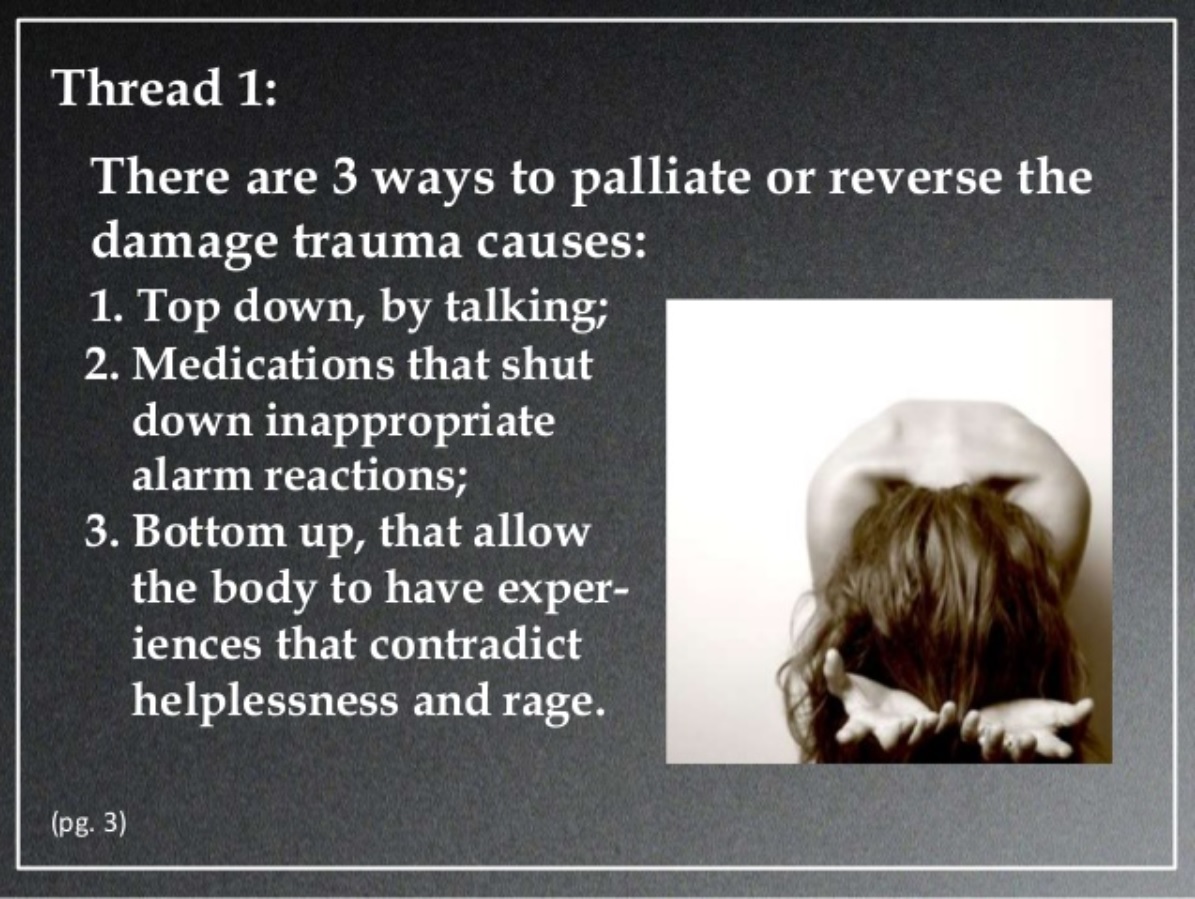
  • The Body: "We can now develop methods and experiences that utilize the brain's own neuroplasticity to help survivors feel fully alive in the present and move on with their lives." The three avenues are: 1. top down, by talking, (re-) connecting with others, and allowing ourselves to know and understand what is going on with us, while processing the memories of the trauma; 2. by taking medicines that shut down inappropriate alarm reactions, or by utilizing other technologies that change the way the brain organizes information, and 3. bottom up: by allowing the body to have experiences tha deeply and viscerally contradict the helplessness, rage, or collapse tha result from trauma." (Bessel Van Der Kolk)


Prologue: Facing Trauma

The following are some of the more profound quotes I found while reading through the prologue of THE BODY KEEPS THE SCORE:

"Traumatic experiences do leave traces, whether on a large scare (on our histories and cultures) or close to home, on our families, with dark secrets being imperceptibly passed down through generations." (Bessel Van Der Kolk)

"It takes tremendous energy to keep functioning while carrying the memory of terror, and the shame of utter weakness and vulnerability." (Bessel Van Der Kolk)

"Feeling out of control, survivors of trauma often begin to fear that they are damaged to the core and beyond redemption." (Bessel Van Der Kolk)

"The key to healing was understanding how the human organism works." (Bessel Van Der Kolk)

"Research from these disciplines (neuroscience, developmental psychopathology, and interpersonal neurobiology) has revealed that trauma produces actual physiological changes, including a recalibration of the brain's alarm system, an increase in stress hormone activity, and alterations in the system that filters relevant information from irrelevant. We now know that trauma compromises the brain area that communicates the physical, embodied feeling of being alive." (Bessel Van Der Kolk)


Preview of upcoming review for the remainder of THE BODY KEEPS THE SCORE:
 
The following are a series of slides which enumerate the main themes explored in THE BODY KEEPS THE SCORE.


Adverse Childhood Experiences (ACEs) Study:
 
Much of trauma can be attributed to three main areas of exposure: abuse, neglect, and household dysfunction, as explored in the Adverse Childhood Experiences (ACEs) Study.


To take the quiz yourself, click here.
 
While you're at it, check out this powerful TedTalk on the ACEs Study:
 
 
*Please note: Your score does not define you or your ability to recover or exhibit resilience. I should know. I scored a 10/10 on the ACEs. Yet, I have somehow survived those traumas. The following are the common risk factors and areas where survivors may struggle to manage their traumas:


I welcome your comments below. What has your experience been like? How is it similar or different than what has been described here? Now what? Now that you have read this post, what is your next step?


Wednesday, August 3, 2016

Book Review: Exit, Pursued by a Bear by E. K. Johnston

Exit, Pursued by a BearExit, Pursued by a Bear by E.K. Johnston
My rating: 5 of 5 stars

Wow. That ending. I have not read such a perfect ending in such a long time. It took my brain a few minutes to process and fully receive the impact. I must have been twirling through the air in a perfect basket toss, positioning myself to be caught by my teammates. Once I stuck the landing, everything snapped into focus and I realize everything had been flipped.

Incredible, impeccable writing throughout. Thoughtful and detailed characterization. I felt like I was on a full cheer squad without mistaking the two Susans, thanks to the pacing and timing by Johnston. The subject of rape and its aftermath may be brutal, yet expertly handled by Johnston as the story unfolds.

At center stage is Hermione and Polly. Two friends who stay true through thick and thin, their senior year and both find ways to have each other's backs in more than one occurrence. Johnston delivers on all fronts, giving air to just about every conceivable aspect of rape and its aftermath, the slow unraveling of one girl's recovery journey. And yet, she leaves room to make the point that there is much more to Hermione Winters than just the facts, whether by police report, or news reporter. And she sure as hell is much more than the rumors, and the victim blaming, and the shaming. To the very last page, Johnston keeps the reader turning pages.

Cheerleading is about precision, execution, and decision. Hermione may have to lose herself to find she was never that far away. As the story comes full circle, she finds within herself the ability to face her past and pave the way for her future based on one simple decision: to use her voice and speak up, when rape robbed her of that choice before. Go ahead. Poke the bear. See how silent the bear is. Bravo. Bravely told. A must read. A powerhouse of a book.

View all my reviews

Sunday, July 17, 2016

Book Review: The Way I Used to Be by Amber Smith

The Way I Used to BeThe Way I Used to Be by Amber Smith
My rating: 5 of 5 stars

Maybe is the word spoken before we make a wish. Like, "I wish..." I wish this never happened. I wish I had stopped it somehow. I wish it had gone differently. I wish I could go back to before. I wish. I wish. I wish.
Eden was probably the kind of girl who might lay in the grass the summer before starting her four years of high school, pulling dandelion puffballs and blowing their seeds into all the wishes she could make for her life, back when it was much simpler to wish, simpler to breathe, simpler to just be.

Back when she was Edy, and before her life went spiraling out of control. A stairwell to a dark cellar where awful things happen, and claw their way back up the stairs from beneath her skin, trying to find a way out.

THE WAY I USED TO BE is raw, unflinchingly truthful, and astonishing in its portrayal of what millions of women, girls, boys, and men, and those who do not align as either, or who remain fluid, suffer through daily.

Sadly, they carry the guilt, the shame, and the fear which belongs to their abuser, as if it belongs to them, as if it is their own. And yet, it's not. It's a horrific lie told to them to keep them a prisoner, stuck on the stairs leading down into the cellar of their minds.

As Eden struggles through all four years of high school, drifting farther and farther away from the girl who used to say maybe, take a breath, and blow her wishes across the lawn or field she laid in, she wonders if she will ever find a way back to that place where she could still choose what her life might be, instead of having it already decided for her, already a nightmare she has to endure as a consequence of his actions. But I could just as easily say her actions, or their actions, depending upon whose story is being told.

As a male, I believe this book should be required reading in every sex ed class that separates out the boys and the girls, telling them how they will become adults. This book makes it crystal clear the devastation, the aftermath, the horror of what it is like for a survivor of rape to struggle through until she finds her voice and a way to speak the truth that has been shoved down so far, she doesn't even recognize herself in the mirror anymore.

Many thanks to Amber Smith, for writing what must have been such a terrible thing to have to write and live inside of for so long, until it was perfect and ready for its readers. No one wants to read about this. But we must. No one wants to talk about this, either. But WE MUST.

There were so many exquisite moments of profound truth and honesty, words of poetry so powerfully concentrated and blasting off the page as I read the lines. This is a book that needs to be processed, pondered, discussed, and shared. I intend to do all of those things, and more.

Thank you so much for writing this book, Amber. It is an honor to know you. Please, write more books chock full of truth and boiled down to the words within these pages. Amazing. Breathtaking. Heartbreaking. Powerhouse of a book. An absolute MUST READ. A book you won't regret, despite the topic.

View all my reviews

Monday, May 23, 2016

The Smell of Smoke: Surviving the Aftermath of Trauma


            Survivors. We smell the smoke. It seeps into our clothing and surrounds us like a heavy fog. Ashes rain down like snowfall, cover us in dust, catch in our eyelashes, and clump under our fingernails. The flames have long since flickered out. Even so, the houses of our lives have burned to the ground in the aftermath of the trauma we have endured. Somehow, we made it through.


           We know what it feels like to sit down in the charred remains, to dig among the rubble, searching for meaning, something to hold onto or bring us back to the present. We try our best. Some days, we are lost. Flooded by memories that feel so real they could be mistaken for right now. Our reality is skewed. Other days, we manage to feel things as we turn them over and over in blackened hands, tracing their edges as if they could construct words and speak to us. These objects are our Braille, and we are blinded and reeling in the aftereffects of all that has happened.


            We probably look strange from the outside. The reality we walk through each day is heavy with silence, guilt, and shame. These things press down hard upon us, like the words we’ve taken in and have running endlessly on repeat just loud enough to hear, but not loud enough to consciously register them anymore. From the outside, you can’t see the devastation, the loss, or what it continues to cost us to survive.
 
           From your vantage point, we look rather like a lost puppy, or a homeless person begging coins and food on the street corner. The urge to turn your head and ignore us is strong. This only adds to the cacophony of silence. For the trauma to have happened, it required silence and tolerance. Looking the other way. None of that helps us. Instead, it further validates our abusers and their actions toward us. If you haven’t yet, this is where you’ll turn away.


            We keep going.


            We walk on hot coals, smoldering beneath our feet, ready to reignite at any moment a spark falls upon our steps. One memory stacks upon another, increasing the heat of the flames that relentlessly burn. Fire ebbs and flows. It comes and goes. At times, it can build until it seems an entire forest is aflame. At other times, the coalbed, while hot, is banked to the back corner of the fireplace, barely keeping the chill off. Yet, still we rub our hands expectantly for warmth.


            We are in the aftershock and there aren’t enough blankets to weigh us down and keep the shivers away. Absentmindedly, our soot-covered hands work through the ash heap looking for something else that made it through the flames, perhaps with scorch marks, but intact enough to recognize. It might as well be a mirror. That’s exactly what a survivor is, too.


            Do you know a survivor? Chances are, you do. One in four women and one in six men, before they turn eighteen, have survived child sexual abuse. The statistics for rape, of both men and women, as well as those from the trans and gender fluid communities, are even worse. All of us are survivors. All of us have endured trauma. We went through the fires. We were likely burned. Many of us are still reeling from the aftereffects. Without support, we might choose a path that includes self-medicating (such as alcohol, drugs, and other substance abuses, addictions such as porn, and self-harm) behaviors.


There is hope. There is a way through the fire. There is life on the other side. Mindfulness may help you get there. Resiliency, too. Recovery is possible. Change is possible.
 
Most importantly of all: YOU ARE NOT ALONE. Many, many others travel with you.


Check out these pinterest boards for survivor resources:


Wednesday, February 10, 2016

Book Review: THE BROKEN HALF by Sahar Abdulaziz

The Broken HalfThe Broken Half by Sahar Abdulaziz
My rating: 5 of 5 stars

Still reeling from the onslaught of pages, I am not sure I can adequately express how profoundly this book has changed me, leveled me to the ground, dropped a building on top of me, throttled me through the jarring effects of an 8.0 earthquake (which I have personally experienced), or otherwise left me an inarticulate glob of human numbed by the harrowing story of Zahar Evans and what she suffered at the menacing hands of her husband Jamal. In one aspect, this is the story of a woman trapped in a difficult situation with no apparent means of escape. Yet, despite this obstacle, Abdulaziz spared no amount of obstacles firmly lobbed at Zahar at a dizzying and often breakneck speed, deftly written in an account that seemed to fly by as if the reader were watching CNN live, or some other streaming news account happening right now.
The setting is modern, and easily incorporated into the background as the story unfolds. Within this story a secondary, yet equally important layer of story paralleled the main plot. A moderate Muslim community, the masjid, the Imam, the brothers and sisters living out their faith, demonstrating their customs, and in a way that the reader can approach even if he or she has zero knowledge of the Muslim culture or religion. I found this aspect of the story fascinating and illuminating as at times characters experience the intolerance and bigotry our culture so easily assumes in the face of anything it doesn't understand. This made me want to read the book all the more.
The characters are well developed and fully realized. Of particular interest, I most loved the marriage of Tamim and Hawadah. Hawadah is a secret best friend of Zahar, and I always delighted in those parts of the story where they were included. Still, I must say that Abdulaziz gave every character a challenge to face, and spared no amount of troubles to sprinkle by the bucket full at nearly every character, beloved or not. I am not one who weeps easily or often. Very rarely, in fact. However, I found myself openly and unashamedly weeping at several times in this book.
Finally, this book addresses the issue of domestic violence in the context of a married couple, and many of the related aspects including the assumption of male supremacy over women, those who are religious, and those who live a life in reverence. Bias, bigotry, prejudice, cultural insensitivity, vengeance, retribution, retaliation, revenge, generational curses, and so on.
This is a powerful story, that may not allow you to do anything else until you sit down and read it cover to cover in one sitting. But it is one that will stay with you long after you've finished, and will call out to you to be pondered and shared. Highly recommended. A must read.

View all my reviews

Monday, January 18, 2016

Preview of my Dear Teen Me Letter and Blog Tour 1/18/16 to 1/31/16

https://paperbacksandwine.wordpress.com/2016/01/18/1733/
 
 
The Packing House Book Tour officially launches today. Click the banner above to check out the full schedule and make sure you stay up to date on all things blog tour leading right up to the book launch party on Facebook on 1/31/16.
 
Since it's a party, of course there's goodie bags and prizes. I hope you'll enter the Rafflecopter below, and check out each stop on the tour over the next two weeks to continue to enter for your chance to win a slew of books and other prizes.
 
For those who like to win things, the book tour will include a chance to win a signed copy of The Packing House and a signed chapbook companion titled, Fish Out of Water:
 
 
Specific to the Book Blog Tour, you can also win your pick of the following paperback books referenced in The Packing House:
 
Fahrenheit 451 by Ray Bradbury
The Chocolate War by Robert Cormier
The Outsiders by S. E. Hinton
Catcher in the Rye by J. D. Salinger
To Kill A Mockingbird by Harper Lee
 
______________________________________________________________________________
 
Now for a peek at my upcoming DEAR TEEN ME letter, which is scheduled to post on May 4, 2016 at www.dearteenme.com


G. Donald Cribbs on graduation day in 1991 from Loudoun County High School


 G. Donald Cribbs on a graduation trip to the beach in 1991.
_________________________________________________________________________
 
 
ENTER THE RAFFLECOPTER BELOW TO WIN!!
 
a Rafflecopter giveaway
 
 
Follow the tour for more chances to win!